





Having your own stable is a dream for many riders, but the journey there requires careful thought. To ensure your horses stay healthy and feel comfortable, many aspects need to be considered from the start: the right location, a good stable climate, sufficient space, and equipment that is safe and functional. With thorough planning, you create an environment where the well-being of your horses comes first and which remains efficient and reliable for many years to come.
The right location for your stable
Before getting into detail, you need the right plot of land. It’s crucial that the stable you envision can actually be built there. This includes not just the location but also the size and condition of the plot. A topographical map helps to assess the site conditions.
Also, you may consider which breeds and how many horses will live in the facility. A stable for ponies has different requirements than a facility for large warmbloods. Furthermore, you should plan for enough space for paddocks, pastures, access roads, and the storage of feed and bedding.
And then there’s the matter of permits. Building regulations vary from country to country, and additional animal‑welfare requirements also apply. Before you start, speak with the relevant authority. A simple preliminary building application provides clarity and, in case of doubt, saves you time and stress.
How much space and which stable system do your horses need?
During the next steps, you may consider which stable systems you want to offer your horses.
Should it be a classic horse stall barn, where each horse has its own defined area?
Would you like to give your horses more freedom of movement in an open stable?
Or are you thinking about an active stable system, which promotes extensive movement through modern concepts?
In many cases, a combination of systems can be the most practical solution. Below, we take a closer look at the individual options:
Horse stall barn
The horse stall barn is the traditional form of equine housing.
Each horse has its own individual space, and you maintain full control over feeding and daily care.
This is especially useful when horses require different feed rations or when individual horses need to be temporarily separated, for example due to illness.
It is, however, important that your horses still have visual and physical contact, so they do not become socially isolated.
In a horse stall barn, this can be achieved through solutions such as our social contact partition, which allows neighbouring horses to see and touch each other safely.
Open stable
In an open stable, your horses live in a herd and typically use a shelter that they can enter or leave as needed. This greatly encourages natural behaviour and promotes movement. This requires – as with all stable systems – a well-thought-out concept for feeding and hygiene that suits the environment.
Active stable
The active stable offers your horses plenty of movement and variety. Incentives for movement, automatic feeding systems, and various functional areas ensure that the animals can remain active all day. This form requires careful planning and investment in technology.
It is important that the chosen stable system fits the overall concept of the facility (sport stable, private stable, or breeding farm) and the horses. The main focus should always be on equine welfare.
Once you know which stable system you want, you move on to planning the stable equipment and the specific dimensions.
- For horse stalls, the rule of thumb is: at least (2 × height at the withers)². For a large horse, this is a minimum of 3.5×3.5 – or better yet, 4×4 metres.
- Aisles should be wide enough for two horses to pass easily. Between 2.5 and 3.5 metres is ideal.
- And the ceiling height also plays a role. The higher it is, the better the stable climate.


The right flooring for your stable
When it comes to stable flooring, it requires extra attention. Different areas have different requirements, so the choice should always suit the overall concept and use.
Aisle flooring
In the aisle, durability is key. Are machines driven here regularly, or just the feed cart? Depending on the requirements, various solutions are suitable:
- Concrete floor – robust and long-lasting, ideal for heavily used areas
- Liquid rubber – seamless, hygienic, and easy to clean
- Paving or rubber bricks – flexible and visually appealing
Horse stall flooring
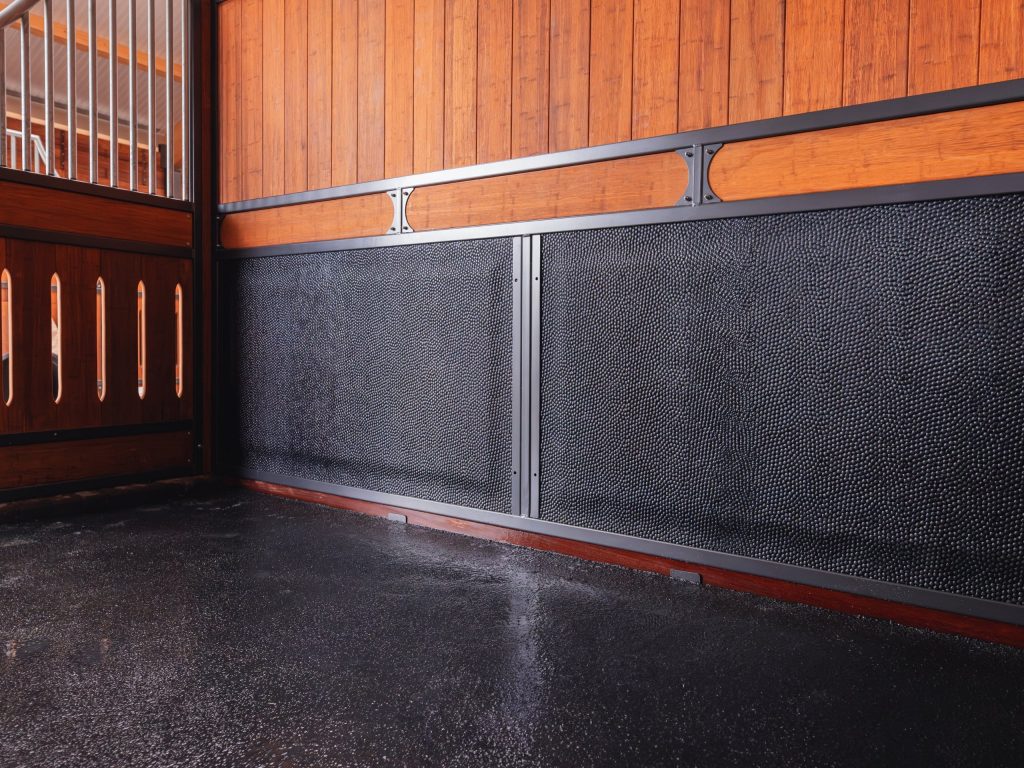
A different floor may be more appropriate in the stalls than in the aisle. It must suit the chosen bedding and mucking method. An elastic rubber floor is gentle on the joints and provides more comfort. Liquid rubber is particularly hygienic as it is applied seamlessly and is easy to keep clean.
Washing and grooming areas
Washing and grooming areas have their own requirements. The floor must be non-slip, easy to clean, and have a slight slope so that water can drain quickly. Concrete with a broom finish – a roughened surface – or seamlessly applied liquid rubber, which is especially advantageous for hygienic reasons, have proven effective here.
Fresh air and good light
A healthy stable climate is essential for your horses. Poor air promotes respiratory illnesses and negatively affects health and performance. Therefore, ventilation and light should be part of the stable planning from the start.
Fresh air
Fresh air must enter the stable evenly without creating drafts. Solutions for this include:
- Summer barn doors consist entirely of grilles and are installed directly behind the barn door. They let air in while ensuring your horses are safely contained.
- Four-winged doors offer another option: the lower area remains closed, while the upper wings can be opened. For additional protection—such as overnight—the upper part can also be equipped with grilles.
- Stable fronts with ventilation slots in the lower area of the bamboo infill ensure a gentle air exchange.
- Stable windows bring additional fresh air into the stable. Options include turn-and-tilt windows, classic latticed windows, or variants with a protective grille.
Technical systems can also help by binding dust and moisture and regulating the temperature. This keeps the air quality constant and helps prevent respiratory problems.
Tip: Systems like R&AIR Care distribute a fine water mist in the stable. It binds dust, bacteria, and odours, regulates humidity, and reduces insect levels.
Natural Light
Light is just as important as fresh air. It supports the natural rhythm of your horses and creates a pleasant environment. Large window surfaces or ridge lights bring brightness into the stable. For the darker hours, the lighting should be evenly distributed so that no shadows or glare are created.
Interior equipment and materials
A stable facility is only as good as its equipment. Doors, barn doors, windows, and stable fronts are used daily and must therefore not only look good but also be stable, safe, and durable.
Horse stalls
A stall is your horse’s home. Safety is therefore the top priority: rounded edges, deburred metal parts, and well-thought-out latch mechanisms reduce the risk of injury. Not only the material itself but also its quality and strength are crucial.
High-quality, hot-dip galvanized steel, solid bamboo, and stainless steel ensure stability, kick-resistance, and a durable, easy-to-clean surface. A powder coating offers the material additional protection and opens up many design possibilities.
Learn more about our horse stalls
Barn doors and stable entrance doors
Barn doors and stable doors must withstand wind, weather, and daily stress. Hot-dip galvanized steel protects against corrosion, and wood infills (mostly made of hardwoods) provide stability and a robust look. We, however, consciously rely on bamboo – a particularly durable and sustainable material. Unlike rainforest hardwoods, it is not only more environmentally friendly but also splinter-free and long-lasting. A powder coating offers additional protection and the opportunity to add colour accents.
Learn more about our barn doors and stable entrance doors
Stable windows
Windows bring daylight and fresh air into the stable. At the same time, they must be safe: stable frames, safety glass, protective grilles, and finishing without sharp edges protect both horse and human. Custom models can be adapted to optimally support ventilation and the stable climate.
Learn more about our stable windows
Material quality
To ensure you enjoy your stable for a long time, pay attention to proven, high-quality materials for all products that are characterized by durability and safety in practice. We rely on the following materials for our products:
- Stainless Steel is a durable material with high corrosion resistance. Its self-healing passive layer constantly renews itself under suitable conditions, ensuring that the surface remains protected and looks elegant long-term.
- Hot-dip Galvanized Steel is protected from corrosion by a zinc layer. This forms a robust barrier against environmental influences – ideal for use in the stable.
- Powder-Coated Elements combine protection and design. The high-quality coating makes surfaces resistant to weather influences and simultaneously gives them a decorative look that can be individually customized.
- Bamboo is an ecological, dimensionally stable, and visually appealing material whose strength is comparable to steel. It does not warp like tropical hardwoods and contains no leachable tannins. Important to know: Bamboo has no natural protection against fungus and algae, so careful maintenance is necessary to permanently maintain its quality.
Stable technology and comfort
Good stable planning considers not only space and materials but also the technology that makes your daily routine more efficient and ensures greater safety. Modern systems save time, relieve staff, and improve the well-being of the horses.
Automatic feeding
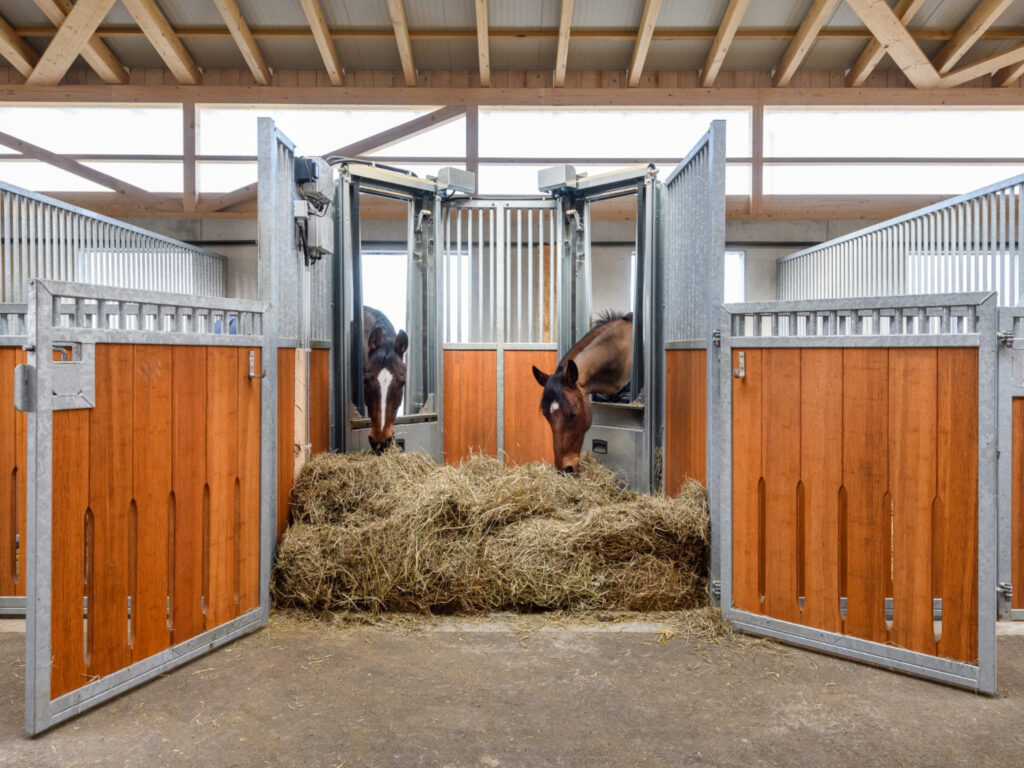
Time-controlled hay dispensers and concentrate feeders allow for an even and controlled supply for the horses. For example, they dispense smaller portions at freely selectable intervals, ensuring those crucial feeding breaks. At the same time, the exact amount each horse receives per day can be precisely controlled.
Drinking bowls and feed troughs
Fresh water and good feed are essential. Drinking bowls should be designed so that your horses have access to fresh water at all times, even in winter. Frost-proof models are particularly important here. An additional safety bar prevents the trough from being damaged.
Feeding troughs also require stability, easy cleaning, and safety. Systems that allow feeding from the outside are practical – for example, via a feeding slot, feeding flap, or rotating trough. This means the stall does not have to be entered, which simplifies the routine in the stable.
Partitions and accessibility
The design of the partitions and access points plays an important role in efficient stable work. Swivelling or sliding partitions make mucking out easier and create more space for individual horses if needed. Wide barn doors can also be useful if machines need to enter the stall area. Which solution fits depends on the overall concept and the work processes.
Comfort areas in daily life
A well-planned stable should also offer space for washing and grooming areas, which can be combined with a solarium if desired. This creates separate areas where horses can be groomed or cared for after training without blocking the aisle or transferring dust to other horses. Solariums support regeneration, promote blood circulation, and help with drying after washing.
Tack and feed room
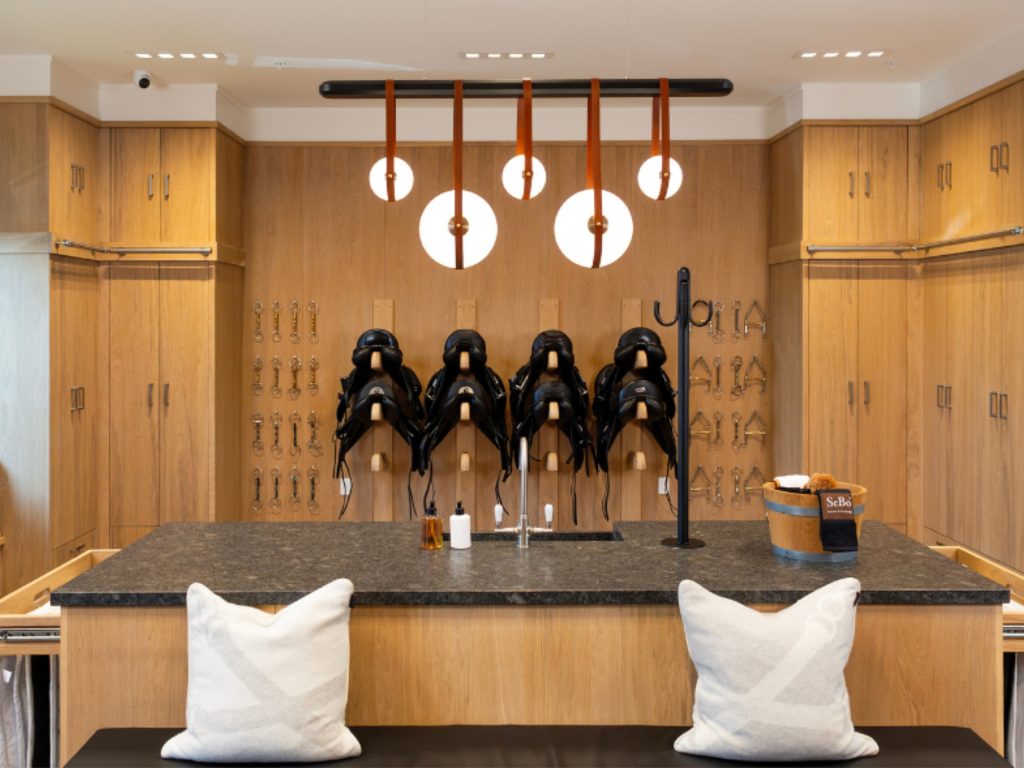
A well-organized tack room saves you time and ensures that everything has its place. Air-conditioned or well-ventilated rooms prevent mould formation on saddles and bridles. Equally important is a hygienically designed feed storage area that remains dry and is protected from pests.
Just as crucial is the correct placement: Tack and feed rooms, grooming areas, power and water connections, as well as the manure heap and access roads, should be arranged so that distances remain short and the routines in the daily stable life function smoothly.
Exercise options
In addition to riding arenas, lunging arenas and horse walkers are valuable additions for training and variety. They relieve pastures and offer all-weather exercise opportunities. Horse walkers are also a good addition to the daily exercise concept – for instance, for warming up or cooling down the horses.
High-quality materials and good maintenance – ensuring your stable remains functional and value-stable long-term
A stable is a long-term investment. While it takes time and effort to keep the stable clean and tidy during operation, if maintenance is neglected, the materials suffer, and the facility loses value. Anyone who wants to enjoy their stable for a long time should therefore regularly maintain it and the stable equipment and have a concept for how these tasks can be easily integrated into the daily routine.
High-quality materials facilitate maintenance
Galvanized steel, stainless steel, or powder coatings are robust and durable if properly maintained. It is important to prevent corrosion and damage—for example, by protecting them from ammonia and having them regularly serviced. Smooth, resistant surfaces are also easier to keep clean and thus contribute to greater hygiene in the stable.
Professional equipment is an investment with foresight
High-quality equipment is more expensive to purchase but quickly pays for itself through longevity and lower maintenance costs. Furthermore, a well-maintained, well-planned stable increases the value of your entire facility.
Expandability is important for more flexibility
Horse populations can change. Therefore, it makes sense to include flexible solutions in the planning: horse stalls that can be connected to form a group pen, space reserves for additional paddocks, or modular systems that can be added later.
Conclusion: Rely on experience and quality
Planning a stable means making many decisions. If you focus on the well-being of your horses while also paying attention to practical routines and high-quality equipment, you create a facility that is safe, functions efficiently in daily life, and brings you joy for many years.
This requires a reliable partner. We are happy to support you! With high quality standards, state-of-the-art manufacturing, and great attention to detail. Step by step, we accompany you from the first idea to the finished facility.
Arrange a personal consultation now.
Frequently asked questions and our answers
What is the minimum size for a horse stall?
For stalls, the rule of thumb is: at least (2 × height at the withers)². This follows the guidelines and recommendations of the FN. For large horses, this means a minimum of 3.5×3.5 metres – or better yet, 4×4 metres.
Do I need a building permit for a stable?
Yes, in most cases, a permit is necessary. Regulations differ depending on the region. A preliminary building application to the authority provides clarity early on.
What does it cost to build a stable?
The costs depend heavily on the size, equipment, and materials. High-quality solutions are worthwhile in the purchase because they save maintenance and repair costs later and are more value-stable.
Which management system is best: Stall Barn, Open Stable, or Active Stable?
That depends on your horses and your options. Stall barns offer control, open stables promote social contact, and active stables combine both with plenty of movement. A combination is often the best solution.
Which flooring is suitable for stables?
The appropriate flooring depends on the use and the overall concept. Concrete is often used in the aisle because it is robust and durable. For stalls, elastic rubber floors or seamlessly applied liquid rubber are also options. It is important that the floor suits the bedding and remains safe and easy to maintain.
How do I ensure optimal light and ventilation in the stable?
Light is provided by turn-and-tilt stable windows, and/or ridge lights in the roof, which evenly distribute daylight. Additionally, well-planned stable lighting is important to avoid shadows and glare even during darker hours.
For ventilation, the goal is to bring fresh air into the stable without creating drafts. This is achieved with various concepts – such as summer barn doors, stable windows with protective grilles, or ventilation slots in the lower part of the stable fronts.
What technology makes my daily stable routine easier?
Automatic feeding, drinking bowls, and movable partitions save time and create calm in the stable. Climate systems additionally increase safety and equine welfare.
How do I ensure that I can expand my stable later?
Choose modular systems that can adapt to changing horse populations. Reserve space for paddocks or additional stalls so that your stable can grow with you.
What is the minimum size for a horse stall?
For stalls, the rule of thumb is: at least (2 × height at the withers)². This follows the guidelines and recommendations of the FN. For large horses, this means a minimum of 3.5×3.5 metres – or better yet, 4×4 metres.