





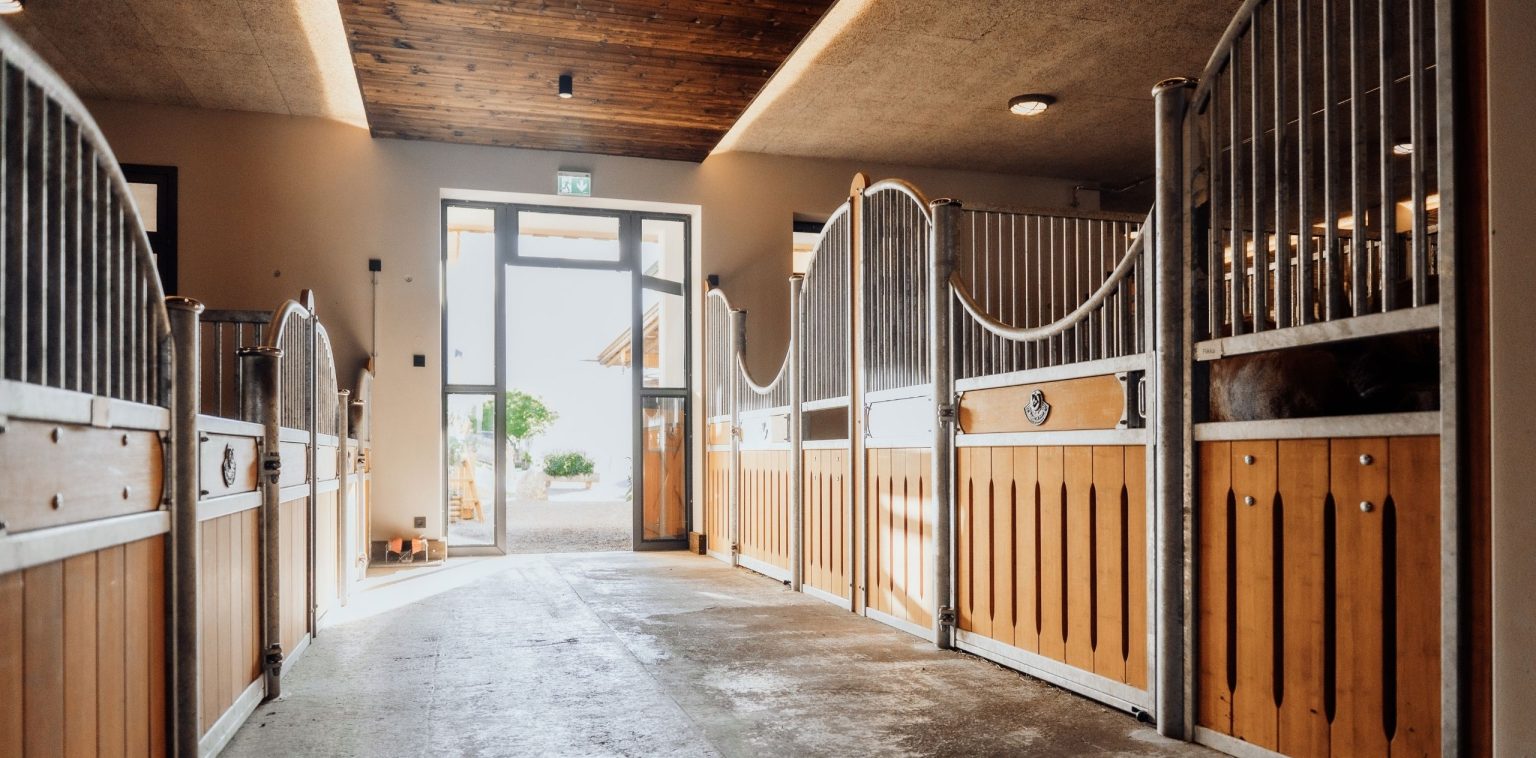
Finding the right stall size for your horse is not as straightforward as it seems. Your horse should feel not only safe, but also comfortable and able to rest and relax.
An ideal stall is neither too large nor too small – it is thoughtfully designed to meet your horse’s individual needs.
In this article, we share which dimensions truly make sense and why it is always worthwhile to think beyond the official minimum requirements when planning your stable.
Legal guidelines and minimum stall dimensions
To ensure every horse has sufficient space, the official Guidelines for the Assessment of Horse Keeping issued by the German Federal Ministry of Food and Agriculture (BMEL) are followed to define clear reference dimensions. These reference values are systematically cross‑checked against the applicable requirements of the respective countries to ensure local compliance.
Although these standards are not legally binding, they serve as an important benchmark for building authorities, veterinarians, and stable designers alike.
The guidelines specify the minimum stall size required for a horse to move naturally, lie down safely, and rest comfortably.
The recommended surface area depends on the horse’s withers height:
| Type of horse | Withers Height | Recommended minimum area |
| Pony | approx. 1.30 m | 6 – 8 m² |
| Small Horse | approx. 1.50 m | 9 – 10 m² |
| Large Horse / Stallion | approx. 1.70 m | 12 m² |
| Mare with Foal | approx. 1.70 m | 15 – 16 m² |
Base formula for stall area
A practical rule of thumb for recommended stall floor area is: the square of twice the horse’s withers height.
For example, for a horse with a withers height of 1.70 m we calculate step-by-step:
2 × 1.70 = 3.40.
3.40 × 3.40 = 11.56 m² → rounded → 12 m².
This area provides sufficient room for everyday movements such as lying down, rising and turning, and should be treated as a sensible minimum in planning.
Minimum width and ceiling height
Besides total area, the stall’s shape matters. The short side of a rectangular stall should be at least 1.75 × the horse’s withers height. For a 1.70 m horse that results in: 1.75 × 1.70 = 2.975 m → rounded ≈ 3.0 m for the short side.
Ceiling height is equally important: in existing buildings a minimum of 1.5 × the withers height is recommended; for new builds a minimum of 2 × the withers height is advised. Heights are measured from the top surface of the bedding (bedding level) to the lowest point of the ceiling. Adequate headroom supports good air volume and circulation, crucial for protecting the horse’s sensitive respiratory tract and maintaining a healthy stable climate.

More space for your horse – why generosity always pays off
Minimum size guidelines define what is necessary, not what is ideal.
They ensure basic freedom of movement, but in everyday stable life they often fall short of a horse’s true physical and mental needs.
From our experience, planning beyond the minimum creates noticeably better conditions, for your horse’s health, for smooth stable routines, and for long-term value.
1. Movement and resting behaviour
Horses only lie down when they feel safe and have enough room to rise without difficulty. In stalls that just meet the minimum dimensions, larger horses often struggle.
Studies confirm that horses in more spacious stalls lie down more frequently, a clear sign of comfort and wellbeing.
2. Air quality and stable climate
The greater the air volume inside the stable, the more effectively dust, humidity, and ammonia can dissipate.
Ceiling height plays a key role: good ventilation prevents coughing and respiratory irritation, particularly in enclosed stable wings.
3. Reduced risk of injury and stress
In small stalls, horses can easily bump into walls or partitions, especially when rolling or turning suddenly.
Generous space dramatically reduces this risk, allowing freer movement, less tension, and a calmer overall atmosphere.
4. Flexibility and future-proof design
A stable is a long-term investment. Larger stalls can easily be adapted for pregnant mares, horses in rehabilitation, or new boarders with bigger breeds.
Well-dimensioned stalls ensure flexibility and future readiness for your facility.
5. Perception and atmosphere
Spacious, well-lit stables convey calmness and comfort. Horses in airy surroundings appear more relaxed and show fewer behavioural issues.
At the same time, a balanced, harmonious stable design leaves a lasting impression on visitors and clients – a key factor for professional yards.
Our recommendations for stall sizes by horse type and use
Not every horse requires the same amount of space.
The ideal stall size depends on several factors – primarily the withers height, but also temperament, level of activity, and how much training or turnout your horse receives each day.

Ponies and small horses
Ponies are agile and robust, yet they also need enough room to lie down and move freely.
For ponies up to around 1.40 m at the withers, we recommend a minimum of 8 m², ideally 9 m².
Active or dominant ponies benefit from additional space, which encourages calm and confident behaviour.
Large horses and warmbloods
Riding and sport horses from around 1.60 m at the withers should have 14 to 16 m² of space. A 4 × 4 m stall, for example, provides enough room for rolling and stretching out after work. Generous, bright stalls promote recovery and well-being, particularly for performance horses.
Coldbloods and heavy breeds
Heavier horses over 1.75 m at the withers require more space, typically 18 to 20 m². In addition to size, structural stability is essential: stronger steel profiles, robust wall panels, and secure locking systems protect both horse and handler.
Broodmares and foaling stalls
Pregnant mares and mares with foals need extra space and tranquillity. A foaling stall should offer at least 16 to 20 m², allowing the mare to move freely during birth and the foal to stand and explore safely afterwards. Many equestrian facilities achieve this by combining two standard stalls with a removable partition – a flexible and practical solution.
Stallions
Stallions are generally stronger and more spirited. Safety and stability are paramount. We recommend a minimum of 16 m², with sturdy construction, higher partitions, and ample air circulation. Visual contact with neighbouring horses also helps reduce stress and promote mental balance.
Young horses and rearing
Young horses thrive in movement and social contact. If individual housing is required, stalls should exceed the minimum standard – 12 m² or more. Ideally, young horses are kept in group pens with plenty of space to encourage natural behaviour and sound physical development.
Rehabilitation and recovery stalls
Injury or illness often means longer stall rest. Generous, quiet, and well-lit stalls support healing: ample space allows the horse to lie down, rise, and move slightly, all vital for recovery and circulation.

Summary of recommended stall sizes
| Type of horse | Withers Height | Recommended stall size | Notes |
| Pony | up to ≈ 1.40 m | 8 – 9 m² | Provides sufficient room for lying down and rolling. |
| Small Horse | ≈ 1.50 m | 10 – 12 m² | More space encourages calm, relaxed behaviour. |
| Large Horse / Warmblood | ≈ 1.65 – 1.75 m | 14 – 16 m² | Ideal for movement and recovery after training. |
| Coldblood / Heavy Breed | over 1.75 m | 18 – 20 m² | Extra area reduces risk of injury. |
| Broodmare with Foal (Foaling Stall) | ≈ 1.70 m | 16 – 20 m² | Ensures safety and calm during foaling. |
| Stallion | from 1.65 m | min. 16 m² | Strong build and generous space for safe movement. |
Checklist for planning the ideal stall size
The right stall size is the foundation of suitable horse housing. These points will help you adapt the dimensions to your horse in a thoughtful and practical way:
1. Define the requirement
Consider which horses currently live in your stable or may arrive in the future. Size, breed, type of use and age all play an important role. Always plan stall dimensions according to the largest horses you expect to accommodate not according to an average value. If the dimensions are based solely on average values, the stalls can quickly become too small for larger horses and no longer comply with animal welfare guidelines. Planning a little more generously is therefore always the better and safer solution.
2. Observe minimum standards and allow extra space
Make sure each stall meets or exceeds applicable minimum size requirements. Horses clearly benefit when they have more space than the legal guidelines prescribe.
3. Consider stall layout and arrangement
Beyond total area, the shape is just as important. Sufficient width, well-positioned doors and visual contact with neighbouring horses all contribute to comfort and safety.
4. Think ahead in terms of use
Consider whether some stalls should be used flexibly when needed for example as foaling, recovery or quiet stalls. Thoughtful planning always pays off in the long term.
If you would like to learn more about planning a stable from choosing the right location through to optimal equipment we recommend our article:
“Planning your horse stable – turning your dream stable into reality.”
Materials and equipment: quality around the stall
The ideal stall size is important – but so is quality of construction. The selection of materials, high-grade workmanship and appropriate equipment determine how safe, durable and easy to maintain a horse stall will be.
Construction and surfaces
Stable steel frames should form the foundation of every horse stall. In our stalls, these frames are also hot‑dip galvanized as standard, providing long‑lasting protection against corrosion. A powder‑coated surface offers additional protection and gives the stall a warm, homely appearance. At the same time, the powder coating is particularly easy to maintain and is available from us in a wide range of colour options.
As an alternative, horse stalls can also be manufactured from high-quality stainless steel. This material is corrosion-free, exceptionally durable, easy to clean and retains its elegant finish for many years.
Depending on budget and application, combined solutions are also possible for example powder-coated fronts with galvanised partitions.

Infills and wall materials
Wall infills must be robust, safe and easy to maintain. Alongside classic hardwood, bamboo panels have proven themselves in extensive practice testing. Thermally-treated bamboo is particularly resistant to impact, splinter-free and dimensionally stable ideal for day-to-day stable use.
In areas where horses tend to kick or stand close to the wall, an additional rubber kick protection panel can be a sensible option.
Safety and workmanship
Safety begins in the smallest detail. Horse stalls must not contain any sharp transitions where horses could injure themselves. All weld seams should be smoothly ground and edges carefully rounded. Bar spacing, door mechanics and fittings must work together precisely.
The German welfare guidelines recommend a bar spacing of approximately 50 mm for stall fronts and partitions. This allows air and visual contact while avoiding the risk of injury.
Air quality and stable climate
Good air circulation is essential for your horse’s well-being. Generous stall space, adequate ceiling height and well-designed ventilation systems help prevent dust and moisture. Our R&AIR Care system further enhances the stable climate by intelligently regulating temperature and airflow.
Light and atmosphere
Light creates orientation and calm. Bright stalls with large windows or grilled fronts promote your horse’s well-being and make daily handling easier.
According to FN‑based guidelines, which also inform FEI practice, stables must provide at least 3% window area, with 5% recommended to ensure adequate natural light. Where natural light is insufficient, artificial lighting should provide at least 80 lux. In working areas, such as feeding or grooming zones, 150 lux is recommended.
Paddock stalls and outdoor access: freedom of movement in everyday stable life
A paddock stall combines a traditional box with a directly attached outdoor area, accessible to the horse at all times. This form of housing is becoming increasingly popular because it combines the advantages of box stabling and open stable systems.
More movement and fresh air
A paddock stall supports your horse’s natural need for movement. The horse can step outside independently, breathe fresh air, stretch or simply observe its surroundings. Particularly in winter or when pasture time is limited the paddock is a valuable way to prevent lack of movement.
Size and safety
The paddock should provide sufficient space, ideally at least as large as the box itself, or preferably larger. A non-slip, secure surface and a stable fence are essential for safety and durability. Doors and locking systems must be designed so that horses cannot open them themselves.
We also recommend a gate with direct outdoor access. In an emergency, such as a fire, the horse can be brought outside quickly and safely. This additional escape route significantly increases safety for both horse and handler.
Weather and location factors
The position of the paddock should take wind and sunlight into account. A roof provides protection from rain and snow, while a south-facing orientation ensures pleasant warmth in winter.
More quality of life every day
Paddock stalls cannot replace regular turnout.
However, they do provide greater freedom, variety and independence in the horse’s daily routine. Horses kept in paddock stalls are typically calmer, more relaxed and show fewer signs of stress.

Conclusion: The right stall size is the basis for well-being and quality
The correct stall size is an expression of responsibility towards your horse. Sufficient space – combined with high-quality equipment, good air quality and opportunities for outdoor movement – creates healthy, content horses and equally happy owners.
As a manufacturer of premium stable equipment, we know that well-planned dimensions and durable materials form the basis of good horse housing. Quality is not only reflected in craftsmanship – but also in the way we approach each project: with attention to detail, respect for the horse and the ambition to create solutions that bring lasting satisfaction for many years.
If you would like to learn more about our horse stalls – or would appreciate personal consultation.
Please connect with us.
What is the minimum required size for a horse stall in Germany?
In Germany, the official welfare guidelines issued by the Federal Ministry of Food and Agriculture (BMEL) state that the stall area should be at least equal to the square of 2 × the horse’s withers height.
Example: A horse with a height at the withers of 1.70 m requires around 12 m².
According to the guidelines, the ceiling height must be at least 1.5 times the horse’s withers height – and for new buildings, twice the height is recommended. Important: The measurement is taken from the top of the bedding to the lowest point of the ceiling.
What regulations apply to stall size in the Netherlands?
In the Netherlands, a legal minimum stall size of 10 m² per horse is expected to come into force from 2027.
For ponies under 1.56 m, the same formula (2 × height at the withers)² applies.
For broodmares with foals, at least 12 m² will be required. The overall trend is clearly moving towards larger stalls and increased freedom of movement.
What stall sizes apply in the United Kingdom?
In the United Kingdom, there are no legally fixed stall dimensions set out in legislation. However, horse housing must comply with the Animal Welfare Act 2006 and the Code of Practice for the Welfare of Horses, Ponies, Donkeys and Their Hybrids. These require that horses are provided with sufficient space to stand up, lie down, turn around, and rest comfortably.
In practice, widely accepted recommendations are followed, particularly those issued by the British Horse Society (BHS). Typical minimum stable sizes are around 9–10 m² for ponies and 12–14 m² for horses, with larger horses often requiring up to 16 m².
The recommended minimum ceiling height is 2.4–2.7 m, with greater height preferred to ensure adequate ventilation and good air quality within the stable.
What stall sizes apply in the United States?
In the United States, stall size requirements are not regulated at federal level and generally depend on state regulations, industry standards, and best-practice guidelines. Most horse facilities follow recommendations from organizations such as the American Association of Equine Practitioners (AAEP) and established industry norms.
Commonly accepted stall sizes range from approximately 9 m² (10 ft × 10 ft) for ponies to 11–14 m² (12 ft × 12 ft or larger) for full-sized horses, with larger breeds benefiting from stalls up to 16 m² (12 ft × 14 ft).
Ceiling height is typically recommended to be at least 2.4 m (8 ft), with higher ceilings preferred to improve ventilation, reduce humidity, and support overall respiratory health.
What stall sizes apply in Canada?
In Canada, recommendations for horse stall dimensions are based on the national Code of Practice for the Care and Handling of Equines, which provides guidance rather than fixed legal measurements. The Code does not specify standard stall sizes in square meters; instead, it uses a calculation method to determine the minimum required space:
Minimum stall area = (2 to 2.5 × height at the withers)²
This formula ensures that the horse can lie down, stand up, turn around, and move freely without restriction.
Housing facilities must provide a clean, dry lying area, safe footing, and adequate ventilation, and must be constructed in a way that allows the horse to raise its head fully and move comfortably. Hallways and box stalls should be designed to facilitate safe movement for both horses and handlers.
The Code does not prescribe a specific ceiling height, but proper ventilation, moisture control, and safe clearance above the horse’s head are required. In practice, ceilings are typically built high enough to support good airflow and ensure overall respiratory health.
Why should you plan beyond the minimum size?
Minimum dimensions only guarantee basic freedom of movement. In practice, significantly larger stalls offer clear benefits:
• Horses lie down more frequently and recover better
• Air quality improves thanks to increased air volume
• The risk of injury and stress is reduced
• Larger stalls can be used more flexibly, for example for broodmares with foals or rehabilitation horses.
What stall size is ideal for ponies, warmbloods or draught horses?
• Ponies (up to 1.40 m): approx. 8–9 m²
• Warmbloods (1.60–1.75 m): approx. 12–16 m²
• Draught horses (over 1.75 m): approx. 18–20 m²
These dimensions are considered optimal to provide sufficient movement space, safety and a healthy stable climate.
How big should a foaling box be?
For pregnant mares and mares with foals, 14–20 m² are recommended.
The additional space allows the mare to give birth safely and the foal to move freely.
Many yards achieve this by combining two standard stalls with a movable partition wall.
What are the advantages of a paddock stall?
A paddock stall gives your horse the freedom to choose whether it prefers to be inside or outside. This encourages movement, social interaction and calm, balanced behaviour.
The paddock should be at least the same size as the stall and feature a secure, non-slip surface, weather protection and safe fencing.
An additional emergency exit via a gate increases safety for both horse and handler.
How large should a stall for two horses be?
Two horses need significantly more than twice the minimum space. As a guideline, at least 20 m² should be provided, ideally 25–30 m², depending on size and social compatibility.
Important: Always ensure sufficient retreat space and two feeding points.